
Jer Catallo
Posted on March 5, 2026 • 5 min read
The Ultimate Mental Reset - Why Every Software Engineer Needs a Musical Hobby
Tutorials can only take you so far. As developers, we spend our days buried in strict logic and debugging. Here is a practical breakdown of why learning an instrument is the ultimate mental reset and how it builds the creativity you need to write better software.
The Ultimate Mental Reset - Why Every Software Engineer Needs a Musical Hobby
For me, this is highly personal. Over my six years as a Software Engineer, I have realized that we spend an enormous amount of time inside logic, structure, debugging, and critical thinking. Those things matter immensely. However, if that is all you train, your mind can easily become too narrow. It is the classic battle of tutorials versus reality. You can memorize syntax all day, but building real, messy personal projects is where the actual learning happens.
Learning an instrument, especially the piano in my case, trains an entirely different side of your brain. It builds creativity, patience, rhythm, and expression. Ultimately, those traits improve your coding routine and your life outside of work.
Cultivating the Creativity That Development Neglects
As developers, we often live inside rigid systems. We deal with strict syntax, edge cases, and absolute correctness.
That structural mindset is important, but it can also make your day feel incredibly rigid. Playing an instrument gives you the space to practice creativity in a completely different way. You are still learning patterns and structure, but you are also learning expression, timing, feel, and interpretation.
That matters because coding is not only about raw logic. Good engineering demands creativity. You need creative thinking when designing a clean architecture, simplifying a massive React component, naming variables clearly, or finding a better way around a CORS error that looked completely blocked at first. It is the contrast of rigid logic versus creative problem-solving.
Keep exploring.
The Ultimate Mental Reset
One of the best reasons to learn an instrument is simple. It helps reset your mind.
After a long day of coding, navigating meetings, debugging, context switching, and staring at screens, your brain is usually overloaded. Sitting down with an instrument gives you a different kind of focus. It pulls you out of Jira tickets, production deadlines, and deployment concerns for a while.
In my experience, this is similar to taking my dog for a long walk to clear my head, or spending an hour stargazing to gain some perspective. It forces you to zoom out. A rested and reset mind always writes better code than an exhausted one.
Active Relaxation Over Passive Consumption
I also think instruments are a great way to relax because they calm the mind while still keeping you entirely engaged.
That is very different from mindless scrolling on social media or just collapsing on the couch after work. When you play music, you are active, present, and focused, but in a way that feels restorative. For a lot of developers, that kind of active relaxation is much healthier than spending even more time consuming content on screens. It aligns perfectly with an anti-burnout pacing strategy. We should prioritize consistency over intensity.
Protect your energy.
Strengthening Attention, Memory, and Problem-Solving
There is also a profound cognitive side to this practice.
Playing an instrument asks your brain to coordinate timing, movement, listening, memory, and concentration simultaneously. That does not mean it magically turns someone into a senior engineer overnight. However, it does train mental skills that are directly useful in technical work.
When I spend time on TryHackMe practicing cybersecurity concepts, or when I play a game of chess, I am actively looking for patterns. The exact same concept applies to reading sheet music or composing MIDI tracks. Attention, working memory, pattern recognition, and problem-solving all play a massive role in writing secure software, reviewing pull requests, and reasoning through complex systems.
[Code placeholder: JavaScript Web MIDI API snippet showing how to listen for 'noteon' events, illustrating how musical inputs map to programmatic logic.]
Piano, Pattern Recognition, and Security
Since I am currently learning the piano, that is the instrument I feel most connected to right now. Lately, I have been diving into making MIDI music, and the technical crossover is fascinating.
The piano is incredibly powerful for developers because it combines strict structure with fluid creativity. You learn scales, timing, chord shapes, and hand independence. You are essentially learning to recognize patterns rapidly. When you develop a security-first mindset, you are doing the exact same thing. You learn to spot the pattern of an SQL injection or a cross-site scripting vulnerability.
The combination feels very familiar to software development. There is discipline, but there is also interpretation.
Write secure code.
The Power of Deliberate Practice
Another reason instruments are fantastic for developers is that they teach patience.
You do not become a great musician by rushing. You improve by repeating small sections, paying close attention to your mistakes, slowing down the tempo, and practicing consistently. That mindset maps directly to engineering and continuous upskilling. It is the constant battle of speed versus safety. Rushing leads to bugs, while deliberate practice leads to mastery.
The same discipline that helps someone improve on the piano also helps them improve in coding. You need small improvements, repetition, honest feedback, and consistency over time.
What the Research Suggests
Research around music and the brain supports the idea that this is much more than just a hobby.
Johns Hopkins Medicine notes that music engages the brain very broadly and describes it as a total brain workout. It also references a study where older adults who took piano lessons showed improved attention, memory, and problem-solving skills.
Furthermore, research highlights that music can help reduce anxiety, improve mood, support mental alertness, and strengthen memory. That lines up exactly with what many developers need most after long periods of mentally demanding work. We need recovery, clarity, and a refreshed mind.
While playing the piano is not a magic productivity hack, there is a very solid basis for seeing it as a healthy practice that supports both mental well-being and cognitive function.
Benefits at a Glance
- Builds creativity outside of strict technical thinking.
- Helps reset your mind after intense debugging sessions.
- Offers active relaxation instead of passive screen consumption.
- Supports attention, memory, and problem-solving through complex coordination.
- Improves pattern recognition, which aids in architecture and security analysis.
- Teaches patience, discipline, and consistent practice for long-term upskilling.
Final Thoughts
I think developers must take their hobbies seriously. We need to prioritize the activities that strengthen the parts of our minds that daily engineering work simply does not reach.
For me, learning the piano is not only about making music. It is about creativity, enforcing a mental reset, finding calm, and becoming a more balanced person. If that balance also helps me think better, code more securely, and live better, that is a massive win.
If you are a developer and you have been thinking about learning an instrument, do not wait for the perfect time.
Start today.
Over to You
What is one non-technical hobby you have picked up that surprisingly changed the way you write code or approach problem-solving?
Photo Credits:
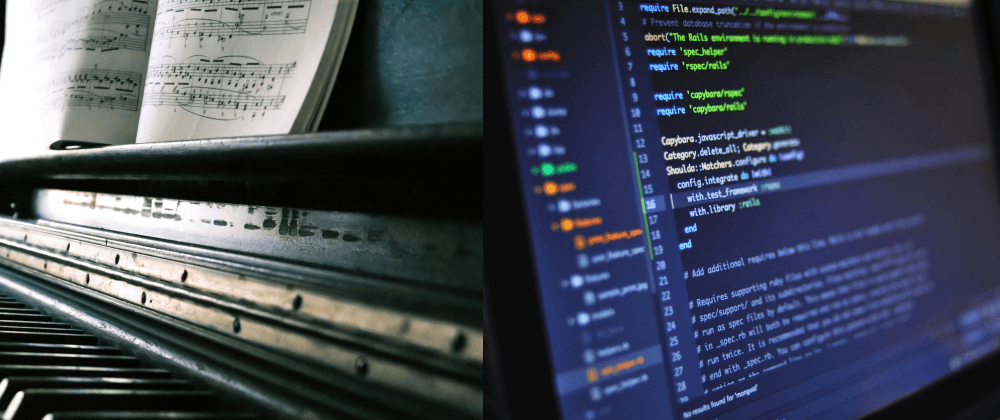
Photo by Luis Gomes: https://www.pexels.com/photo/close-up-photo-of-programming-of-codes-546819/
Photo by Steve Johnson: https://www.pexels.com/photo/music-sheet-on-black-piano-860662/